Free Tin Can Voice Effect
Talk through a free tin can on a string.
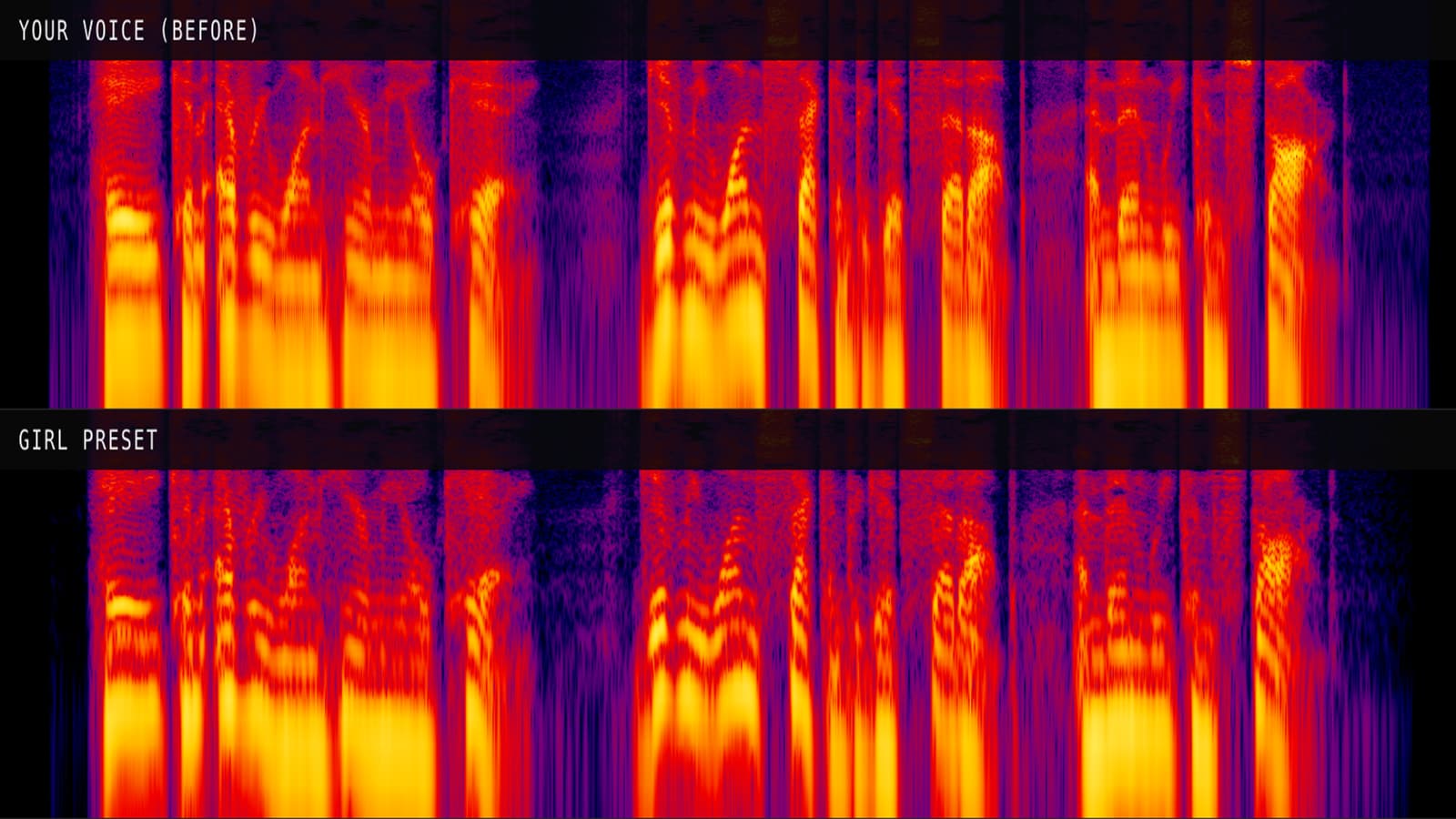
Before and after

Your browser will ask for microphone access when you click.
More versions
Variation: Treble cut at 1.8 kHz: a longer string, less gets through.
Variation: Bass cut down to 400 Hz with a longer ring: a coffee can.
Use it in calls and on recordings
Try it here
Press Start mic above and talk. You hear this voice with the exact settings on this page, and every slider can be moved.
Use it live
Press Use this voice in calls, then pick Facecam Virtual Mic as the microphone in Discord, Google Meet, Zoom or any other call that runs in Chrome.
Put it on a recording
Open Online Voice Changer, record or upload a file, choose the same settings and download the result.
 Voice changer for DiscordA free voice changer for Discord voice chat: open discord.com in Chrome, pick Facecam Virtual Mic, and talk in a new voice.
 Online Voice ChangerA free online voice changer with no sign-up: upload or record audio, pick one of 26 voices and download a WAV. Nothing is uploaded.
 Live Face SwapLive face swap for Meet, Zoom and Discord: become anyone you want, in real time, while you talk. Upload any photo or pick a built-in face.
More about this voice
How a can and a string shape a voice
| Part | Setting | What you hear |
|---|---|---|
| String | Bass cut below 700 Hz, treble cut above 2.5 kHz | Only a sliver of the voice gets through |
| Ring | Midrange +9 dB around 1.5 kHz | One note of the can sings along with every word |
| Metal walls | Flanger 0.1 times a second, 50% mix | A hollow, tubular colour that shifts very slowly |
| Rattle | Distortion drive 0.2, 40% mix | The bottom of the can buzzing on loud sounds |
Shout down the string
- Speak up, as if the other person is at the far end of a garden. A raised voice has more energy in the band that survives.
- Open your vowels wide. Sounds like A and E sit near the 1.5 kHz ring and make the can sing; a mumbled O or U nearly vanishes.
- Keep messages short and childlike: a password, a secret, a question that needs a yes or no.
- Cup your hands around your mouth while you talk. It changes your real tone in the same direction and adds to the effect.
Tin can, telephone or walkie-talkie?
The telephone voice is a wider band with digital grit: an electrical line. The walkie-talkie adds crackle and overdrive: a radio. The tin can has neither. It is purely acoustic, much narrower than both, and defined by one ringing resonance. That makes it the right pick for childhood scenes, treehouse stories and toy characters. Two variations change the can. With the treble cut lowered to 1.8 kHz the string is longer and less gets through. With the bass cut at 400 Hz and the ring moved down to 900 Hz it becomes a bigger coffee can, lower and boomier.
The exact settings
| Setting | Value |
|---|---|
| Noise gate | mutes the mic below -50 dB, between words |
| Distortion | drive 0.2, 40% mix |
| Flanger | wobbles 0.1 times a second, 50% mix |
| Bass cut | below 700 Hz |
| Treble cut | above 2.5 kHz |
| Midrange | +9 dB around 1.5 kHz |
| Compressor | steadier volume (5:1 from -26 dB, then +5 dB) |

Free Tin can voice effect FAQ
Why is the tin can voice so quiet in the low notes?
Everything below 700 Hz is removed, as a string would do. Lower the Bass cut toward 400 Hz, as in the coffee-can clip, to get some body back.
Can I put the effect on a song vocal?
Yes. Upload the vocal to the Online Voice Changer, apply these settings and download it. It's a common trick for an intro or a bridge.
Does it work in Google Meet?
Yes. Meet runs in a Chrome tab, so after you start the voice here you can choose Facecam Virtual Mic in Meet's audio settings.
Other voices
- Dwarf
- Wizard
- Bitcrusher
- Glitch
- Police radio
- Military radio
- Astronaut
- Pilot
- Drive-thru
- PA system
- Train station announcement voice
- Old-time radio
- Cassette tape voice effect
- Lo-fi
- Distorted
- Muffled voice effect
- Gas mask
- Reverb
- Cathedral voice effect
- Bathroom reverb voice effect
- Tunnel voice effect
- Canyon echo voice effect
- Slowed
- Nightcore



Related




 Mic TestA free online mic test with no sign-up: check your volume, background noise and distortion, then play back 10 seconds of yourself.