How Do Voice Changers Work?
How voice changers turn your voice into a girl, a giant or a robot, explained with pictures of the same sentence before and after. Plus what AI voice changers do differently.
By Facecam team
Published · Updated · 6 min read

On this page
Short answer
A classic voice changer changes two things about your voice: pitch (how high or low the notes are) and formants (the resonance that makes a voice sound big or small), then adds effects like distortion or a metallic buzz. It works on the sound wave directly, so it's instant and runs on your own computer. An AI voice changer works differently: it recognises what you said and how, then re-speaks it in another voice, which sounds more natural but needs more computing power.
Your voice is a buzz from your vocal cords, shaped by your throat, mouth and nose. A voice changer can't reach into your throat, but it can change the sound wave on its way out. Nearly every effect you've heard is a mix of three tricks.
What does a voice changer change?
| What | In plain words | Turn it up and you get |
|---|---|---|
| Pitch | How high or low the notes of your voice are | Higher: younger or female. Lower: deeper or older. |
| Formants | The resonance of your throat and mouth, which tells listeners how big the speaker is | Up: a smaller head. Down: a giant. |
| Effects | Extra processing: buzz, distortion, echo, filters | Robots, radios, monsters, phone calls |
The trick is moving pitch and formants separately. If you only raise the pitch, you get a chipmunk: the old sped-up tape sound. Raise the formants with it, a little less, and you get something that sounds like a different person instead of a cartoon. You can hear the difference on your own voice with our online voice changer: record a line, pick the Girl voice, then move only the pitch slider.
What does that look like?
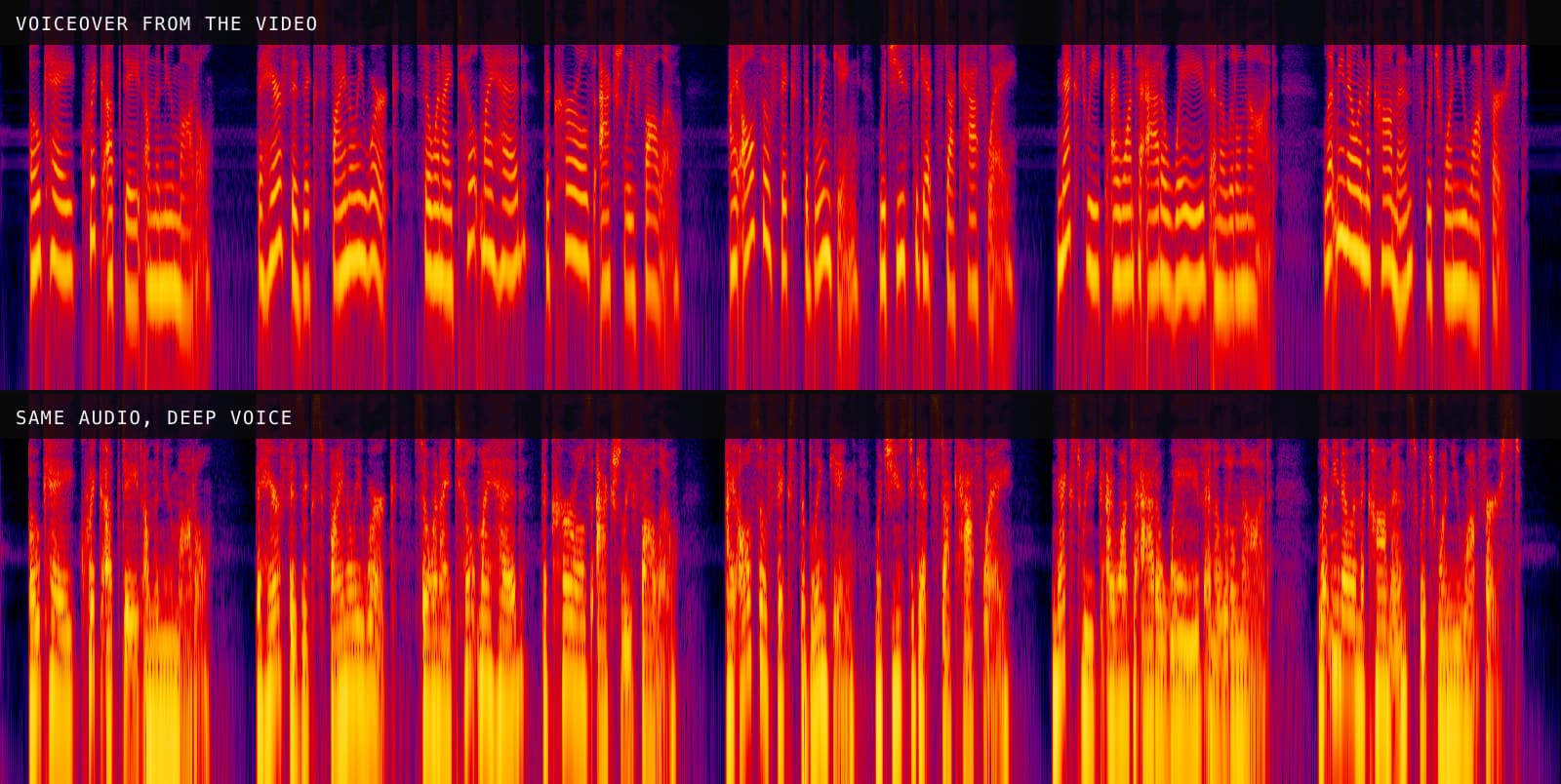
A spectrogram is a picture of sound. Time runs left to right, low notes are at the bottom, high notes at the top, and brighter means louder. Here's one sentence, "Hey, can everyone hear me okay?", before and after three of our presets:

- Girl raises the pitch 8 semitones and the formants 2. The stripes (the harmonics of the voice) spread out and move up.
- Deep lowers the pitch 7 semitones and the formants 3, then evens out the volume. The stripes squeeze together near the bottom.
- Robot doesn't change the pitch at all. It multiplies the voice by a 55 Hz tone (that's the metallic buzz), adds a resonant flanger and crunches the sound to 10-bit. You can see the voice smeared into vertical bands.
Before
Girl
Deep
Robot
How does a voice changer work live, in a call?
A live voice changer does the same thing in tiny slices, many times a second. It takes a few milliseconds of your mic, changes it, and passes it on while the next slice arrives. That delay has to stay small or you'll talk over people. Our pitch shifter works on windows of about 20 ms, so at 48 kHz it adds 18.7 ms, plus 1.5 ms for the limiter that stops loud bits from clipping. Effects without a pitch change, like Robot, add almost nothing.
Then the changed sound has to reach your call. Desktop apps like Voicemod add a virtual microphone to your computer that every app can pick. A browser real-time voice changer like ours can only reach websites open in Chrome, through our extension, where it shows up as a mic you pick in Meet, Zoom on the web or discord.com. Our voice changer hub lists which of our tools work where.
How are AI voice changers different?
An AI voice changer doesn't bend your sound wave. It's trained on recordings of a target voice. When you speak, it works out the words, timing and tone of what you said, then generates new audio of the target voice saying it the same way. That's why it can make you sound like a convincingly different person, and also why it needs a strong computer or a server, adds more delay, and sometimes garbles words it didn't catch.
Newer models don't even need training on each voice: they copy a voice from a short reference recording. Live AI voice changers still can't work word by word. They re-speak your voice in short blocks and have to hear a little of what comes next before finishing each one, so you hear yourself a moment late. Our AI Voice Changer avoids that by working on a recording: you record or upload a clip, and it re-speaks the whole thing in the voice you pick.
Juniper (AI)
Basalt (AI)
| Pitch and effects (Real-Time Voice Changer) | AI voice (AI Voice Changer) | |
|---|---|---|
| Where it runs | Your device, in the browser | Our servers, on a graphics card |
| Live? | Yes, about 20 ms of processing | No: it changes a recording |
| Works in calls | Yes, through our Chrome extension | No, it makes a file |
| Your voice uploaded? | No | Yes, the clip you change |
| Classic (pitch and effects) | AI (voice conversion) | |
|---|---|---|
| How it works | Changes the sound wave directly | Re-speaks what you said in a trained voice |
| Sounds like | You, transformed | A different person |
| Delay | Very low | Higher |
| Runs on | Any computer | A strong computer or a server |
| Good for | Effects, characters, fun | Realistic character voices |
Why do voice changers sometimes sound robotic?
- Big pitch shifts. The further you move pitch, the more artificial it sounds. Shifts of a few semitones sound natural; a full octave rarely does. Our Girl and Deep presets move 9 and 7 semitones.
- Pitch without formants. Without the formant shift, high voices sound like chipmunks and low ones like slowed tape.
- Noise in your mic. The changer changes the noise too. A fan becomes a weird whine. Fix your mic first (our mic guide covers it).
- Your own voice is far from the preset's target. Presets are tuned for an average adult speaker. Ours has Pitch and Tone sliders so you can fit a preset to your voice.
Questions
Do voice changers change your accent?
Classic ones don't: they change how your voice sounds, not how you pronounce words. Some AI voice changers carry a little of the target voice's style, but your accent mostly comes through.
Is a voice changer the same as text to speech?
No. A voice changer transforms your voice as you speak. Text to speech reads typed text aloud in a generated voice.
Can people tell I'm using a voice changer?
Often, yes, especially with big pitch shifts or effects like robot. Small shifts and AI voices are harder to notice.
Does a voice changer work in games?
Desktop voice changers with a virtual mic do. Browser-based ones like ours only reach calls on websites open in Chrome on a computer, not games.
Do voice changers need a good computer?
Pitch and effect changers run on almost anything; ours runs in a browser tab, even on a phone. AI voice changers need a strong graphics card if they run on your computer, or a server and an internet connection if they don't.
How do hardware voice changers work?
The same way as the pitch and effect kind: a small chip does the processing between your mic and whatever it's plugged into. That's why they work with phones and consoles without installing anything, but they rarely offer AI voices.
Why is there a delay with AI voice changers?
The model has to hear a short block of speech, plus a little of what comes next, before it can re-speak it, so a live AI voice lands a moment behind you. Ours sidesteps the delay by changing recordings instead of live speech.
Keep reading
Voice
Do AI Voice Changers Sound Real?
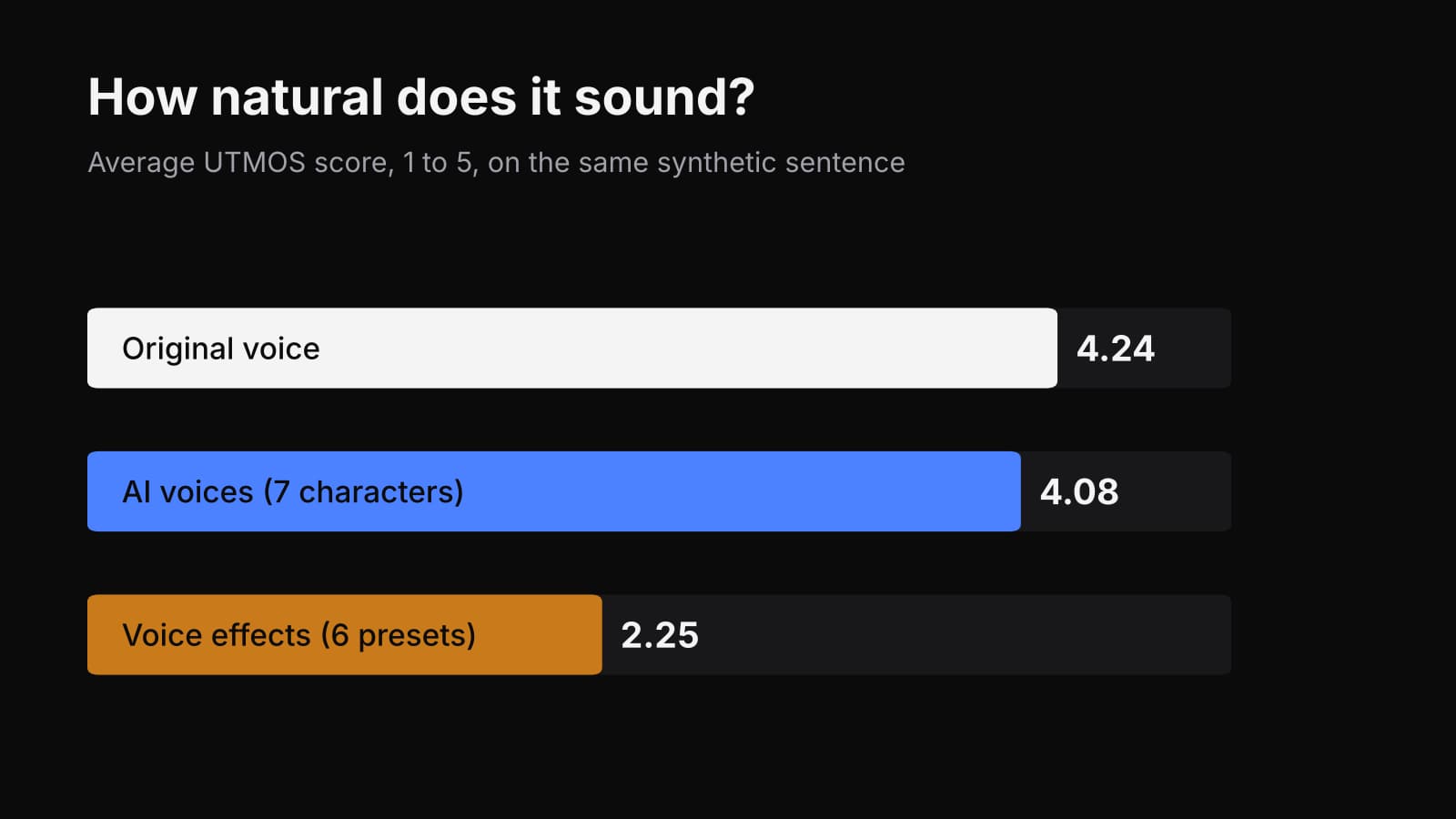
Do AI voice changers sound real, or just less fake than a pitch shifter? We put one sentence through seven AI voices and six classic voice effects and measured all thirteen.
7 min read
Voice
How to Change the Voice in a Video
You can change the voice in a video for free in a browser tab, without uploading it anywhere. We did it with a 17-second voiceover and a 9-minute file and timed every step.
4 min read
Voice
Is Voicemod Safe?
Yes, Voicemod is safe if you download it from voicemod.net or the Microsoft Store. Below: what it installs, what its privacy policy says it collects, and the few real risks, checked against Voicemod's own pages on October 8, 2026.
7 min read


Free, in your browser
Real-Time Voice Changer
Real-Time Voice Changer is a browser tool that changes your microphone voice live and sends it to calls and streams in Chrome.
Open Real-Time Voice Changer


